10 good reasons for taking to the A41 motorway
It’s a race against the clock on the A41 motorway: 1,300 men and 180 machines are putting their all into it between Saint-Julien-en-Genevois and the Villy-le-Pelloux/Saint-Martin-Bellevue interchange in order to hasten the completion of the last link in this motorway combining highly technical engineering skills and a broad variety of specialist expertise with preservation of the spectacular natural backdrop of Upper Savoy. The A41 motorway is worth learning to drive: in 10 easy lessons.
1) On the back burner for 20 years

Construction of the A41 motorway was listed on the national roads master plan in 1988. In 1995, a contractor was named preferred concession company for its construction. “Just when the design work and archaeological mitigation investigations had begun,” recounts Régis Lanaud, technical director of Adelac, “things came to a grinding halt in 1998 because of a change to the procedures for appointment of infrastructure concession companies.” A new, pan-European call for tenders was issued in 2003, and was won by Adelac on 28 October 2005.
2) It will change the face of the region
Better access to and from Upper Savoy, and easier cross-border movement: in addition to linking Geneva to Grenoble by a more direct route, the A41 will shorten the motorway drive from Geneva to Annecy by 27 kilometres. The existing motorway between the two towns, the A410, is a much more roundabout route. The northern stretch of the A41 will also relieve traffic on the RD1201 local road which is becoming more and more congested with increasing numbers of commuting cross-border workers. In addition, it will be an extra route southwards for international traffic from Geneva and beyond.
3/ Nothing stands in its way
All the problematic parts of the A41 motorway are condensed into just 19 kilometres: mountain slopes, complex geology with very different foundation qualities, enormous volumes of earthmoving, a million cubic metres of soil to be excavated for the cut-and-cover tunnel, deep valleys, fine soils requiring special treatment, etc. On top of that comes the difficulty of access to the work sites and the construction of several kilometres of haulage roads. Unstable ground had to be consolidated and underground water flow properly drained away. A further complication is that the project is located close to residential zones. This required close cooperation withlocal representatives, residents, professional organisations, farmers, and representatives of associations: more than 86 meetings were held. “Working in periurban surroundings raises a lot of questions,” stresses Simon Bonne (DTP Terrassement), roadway works director with the GIE A41 consortium: “So we set up a procedure for responding to queries in the shortest possible times.” For the moment the project and the environment have managed to coexist successfully.
4/ It cares for the environment
White-clawed crayfish, yellow-bellied toads, trout and other protected species can put their minds at ease. With a partially covered cutting, full compliance with different regulatory requirements, and measures sometimes going further than the thresholds set by regulations, the A41 aims to be squeaky clean in environmental terms. This meant reducing deforestation to the strict minimum, substantially reducing the motorway landtake and opting for a bridge over the Ravoire stream in order to protect the habitat of the white-clawed crayfish. Earthmoving was optimised, and permanent and temporary storage areas will be reinstated to agricultural quality. Everything is being done to limit the environmental impact of the project.
5/ Highly technical highway
After the development phase, the first earthworks began at the end of May 2006. “Work on the roadway involves earthmoving, drainage, pavements, culverts, the cut-and-cover tunnel, fencing, planting, signage, safety equipment and all the associated engineering,” observes Simon Bonne. It was important to start work in as many places as possible, particularly places providing access to structures like viaducts, the tunnel and interchanges. Other jobs entrusted to the road-construction crews were liaising with local administrative authorities (mayors, agriculture and forests, public works) and residents, and finding new engineering solutions, in conjunction with the design engineers: “The scope of action of our earthmoving crews gradually expanded to include local residents, local authorities, all kinds of other bodies, and project management as a whole,” beams Laurent Masson, deputy head of works with DTP Terrassement.
6/ Adelaide, a talented boring machine
Adelaide, the 12-metre diameter TBM (tunnel boring machine, for most people) emblematically associated with the A41 motorway project, was ordered in July 2005, before the concession contract was even signed. How does it work? Under the combined effect of rotation of the cutterhead at a speed of 4 rpm and the thrust of 24 hydraulic cylinders, an array of steel cutter-discs chips away at the rock. The broken rock passes through the cutterhead and mucking buckets load it onto conveyor belts for removal to the surface. The TBM is a veritable mobile factory: apart from the tunnelling shield at the “sharp end”, the machine consists of 11 backup gantries providing all the requisite logistics support and serving as work platforms for ancillary operations and erection of the reinforced-concrete lining segments installed against the tunnel wall. The backup train is also designed to allow for installation of the service culvert in the tunnel floor as the machine advances. Since the tunnel has two separate bores, the TBM has to be taken back to its starting point: the cutterhead and shield have been taken apart at the southern portal and trucked back to the northern portal where the TBM will be reassembled for excavating the eastern bore.
7/ Triumphant in Mont-Sion tunnel
October 2006: the TBM began the drive for the western tube, starting from the northern portal. “It’s been all go right from the start,” explains Dino de Lorenzi, Bouygues Travaux Publics works director for the 3.1-kilometrelong tunnel. The work involves excavating the tunnel and erecting its segmental lining, building the tunnel portals and plant rooms, and installing service equipment, ventilation, lighting, and the AID* system, all of which is controlled by the central supervisory control centre, “PC César”**... and all in just 18 months.
Geological prediction
The TBM chews through the rock at a rate of 160 metres per week. On the menu for the tunnel excavated in open mode: mollasse, sandstone, clay and glacial moraine. With the risk that the 12 major faults identified might stick in its gullet. But as a result of reliable geological predictions, no problems were encountered on the first drive.
Swiss method
The “Swiss method” of lining erection was adopted. This involves installing segments inline, with the key segment always at the bottom. Pea gravel is injected between each ring and the rock, enabling water from the surrounding rock to drain freely to the bottom of the tunnel. Working in three eight-hour shifts for the first tube and two eight-hour shifts for the second, the tunnellers will erect 1,500 lining rings per tube, or 18,000 segments and 90,000 cubic metres of concrete.
Other works
The tunnel will also have seven cross passages (four for pedestrians and three for vehicles) that can be used for evacuating one tube via the other. There are also 74 fire and emergency refuges in each tube. The ventilation system is capable of rapid smoke extraction in the event of fire. In addition, the permanent lighting, high-voltage cable (20,000 V ), and fire-detection system are being installed as the tunnel advances, making for scheduling time savings. The first tube broke through on 12 June 2007. Excavation of the second tube will start in September.
8/ Four audacious mountain viaducts
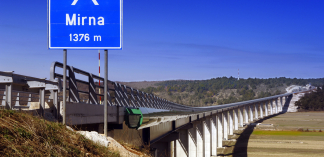
“Bridging the relatively narrow and sometimes very steep ravines and V-shaped valleys has been no easy task,” admits Jean-Luc Bouchet, viaduct manager for the GIE Constructeurs consortium. The task ahead for the 40 siteworkers (there were 66 of them in December) and 25 supervisors assigned this job: the three “Nant” viaducts – “nant” is Savoy dialect for “mountain stream” – each with twin decks made up of twin steel girders supporting a reinforced-concrete deck slab, and the Usses viaduct, a single-deck structure using precast deck panels. All four being built simultaneously. They will require some 28,000 cubic metres of concrete and 6,600 tonnes of structural steel. Enabling works began at the end of May 2006: the smallest possible amount of deforestation and construction of access roads to the pier foundations. Construction of the deep foundations began in July, followed by construction of the first piers. Work on the structural steelwork for the decks, which began in March 2007, will run through till the end of the year. In September the first travelling deck forms will be set up and will be used to build the reinforced-concrete decks through until June 2008. Then, up until September, the bridge equipment, cornices, drains, pavement joints, and safety barriers will be installed. The end of summer 2008 will see all four viaducts completed, not far from their famous forebear, the Caille bridge!
9/ Ultramodern toll plaza
The toll plaza will have 29 gates. The Villy-le-Pelloux/Saint-Martin-Bellevue toll gates, construction of which is under the supervision of Emmanuel Storksen, deputy works director in charge of standard structures, is important in more ways than one. The revenue of a private motorway concession comes from tolls, which requires total equipment reliability and efficiency.
Integration into existing systems without disturbing operation
The northern stretch of the A41 motorway will be connected to the southern section of the A41 and the A40 motorway. Its management systems will be integrated with the existing systems of AREA, the motorway operator. This particularly concerns computer systems allowing the operator to dialogue instantly with the central servers. The other difficulty is construction of the main toll gate structure on a “live site” in Villy-le-Pelloux, just 50 metres from the existing gates which are still operating but which will soon be demolished. There will be three remote-controlled automatic toll gates in addition to the future main gates.
Global offering
“For this project ETDE made an all-in-one offer combining all the skills required for toll systems, power-voltage systems (high and low voltage) and communication-voltage systems (telephone, intercom, video, etc.), automation and safety systems, networks and communication,” explains Yves Lieffroy, senior works engineer. Keeping the existing motorway operating while grafting the northern leg of the A41 onto it and installing and connecting up automatic tolling equipment is a major "first" for the AREA network.
10/ 55-year concession
The GIE Constructeurs A41 consortium was appointed to design and build the A41 motorway by Adelac, a private consortium of large companies (Autoroutes Rhône-Alpes (AREA), Bouygues Construction, Colas, Setec, Caisse d’Epargne des Alpes) that won a European call for tenders. Adelac will operate the motorway through AREA, which already operates the southern part of the A41, for 55 years. Soon, 23,000 vehicles will drive through the Villy-le-Pelloux toll gates and along the 19 kilometres of new road every day: thanks to the A41 North, Upper Savoy – a paradise for skiing, Mont Blanc, and the local culinary delight, a cheese and potato speciality called tartiflette – will be easier to get to.
* Automatic Incident Detection
** AREA motorway network safety centre
The A41 by numbers
- 29 months to build
-
18.8 kilometres long
-
Construction contract amount: €601 million
-
Bouygues Construction share: €460 million
-
3.1-kilometre-long dual two-lane twin-tube tunnel beneath Mount Sion
-
4 composite steel and concrete viaducts built simultaneously (264 metres, 270 metres, 212 metres and 360 metres long)
-
around 30 standard bridges, culverts, etc.
-
1 cutting, including cut-and-cover section (Noiret, 1,800 metres long, 290 metres c/c)
-
2 motorway interchanges (Saint-Julien-en-Genevois & Villy-le-Pelloux)
-
2 interchanges with national highways (Cruseilles East & West)
-
2 half-interchanges at Copponex
-
1 toll plaza at Villy-le-Pelloux
-
2 service areas near the Caille bridges