Date
17 June 2026
By
Bouygues Construction's Press Department
Category
Press release
Bouygues Construction to build a new cutting-edge university hospital in Montenegro
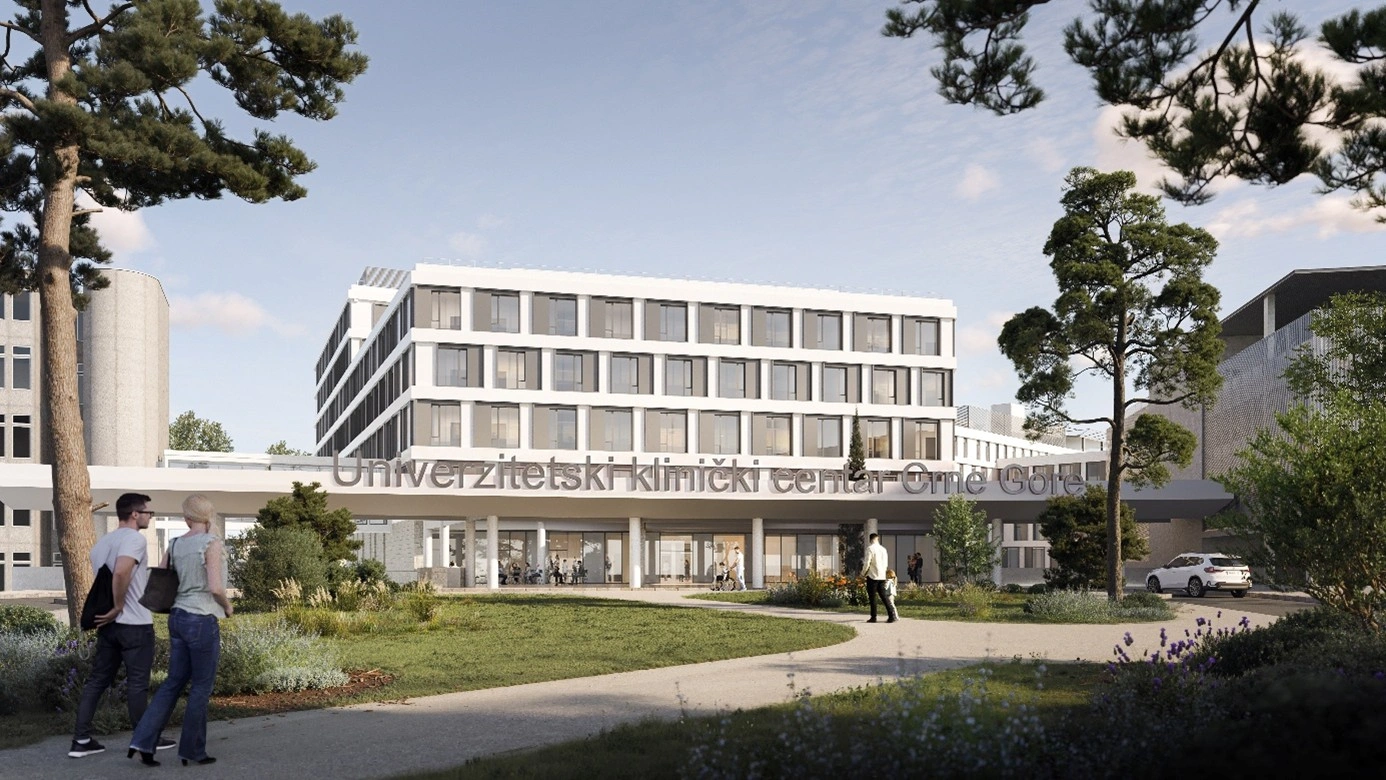
Bouygues Bâtiment International, a subsidiary of Bouygues Construction, has been selected by the Montenegro Ministries of Public Works and Health to design and build a new state-of-the-art university hospital, under the terms of an intergovernmental agreement between France and Montenegro.
The contract was signed by Majda Adžović, Minister of Public Works, and Christophe Petit, Executive Vice President in charge of business development of Bouygues Bâtiment International.
The new 562 hospital-bed complex, which will be located in the capital city, Podgorica, on the site of the current Clinical Centre of Montenegro, will be attached to the University of Montenegro Faculty of Medicine.
A leading university hospital for healthcare, research and education
The new University Hospital in Podgorica forms part of Montenegro’s efforts to modernise its healthcare system. The country has committed to upgrading its medical infrastructure, making it a national priority. Against this backdrop, the new project will strengthen healthcare provision in Montenegro and establish the hospital as a state-of-the-art regional centre that can treat patients from neighbouring countries.
The new complex will benefit from state-of-the-art facilities, including:
- a fully equipped surgical unit including 14 theatres for adults and 5 theatres for children,
- 117 intensive care units,
- an accident and emergency department,
- laboratory research facilities,
- amenities for teaching and medical training (library, lecture theatres).
There will be a direct link with the University of Montenegro Faculty of Medicine, providing better training for medical students.
A facility respecting the strictest environmental and seismic standards
The new hospital is aiming for LEED (Leadership in Energy and Environmental Design) Silver environmental certification and will comply with the European Energy Performance of Buildings Directive. It will meet nearly zero-energy building (NZEB) standards, with the target of a 10% reduction in energy consumption compared to national NZEB thresholds.
The complex will be fitted with solar panels, amongst other things.
As Montenegro is located in a seismically active region, Bouygues Bâtiment International’s teams will implement appropriate engineering solutions, including the use of post-tensioned slabs, to ensure the building’s long-term resilience and performance. The new hospital will be designed and constructed in accordance with stringent seismic standards.
Ensuring continuity of care throughout construction
The hospital will be built in stages, involving 700 site workers at peak times, to ensure that the current Clinical Centre of Montenegro can continue to operate. A collaborative approach will be adopted with the Clinical Centre’s teams to coordinate the building works as effectively as possible, minimising their impact on the quality of care provided.
Philippe Jouy, CEO of Bouygues Bâtiment International, said: “This is an ambitious project that will directly benefit the residents of this country as well as the wider region. In close collaboration with our client and partners, we are committed to creating a high-performance university hospital that will support changes in healthcare practices, teaching and research in Montenegro for many years to come.”
The first stage, involving design development, was launched in June 2026. The construction phase is expected to begin in 2027, subject to financial close.
Bouygues Construction further strengthens its position as a leading global player in the healthcare sector, leveraging its expertise in the design, construction and refurbishment of healthcare facilities. In the past ten years, the company has completed more than 300 healthcare facilities, including the Trousseau University Hospital in Tours and the new mother and baby unit at Rennes University Hospital, both in France, the Oriel Eye Care & Research Centre and the Proton Beam Therapy Centre, both in the UK, the Mohammed VI International University Hospital in Morocco, and the Ryde Hospital Redevelopment in Australia.
Recommended Reading
Explore our latest events, news, and sustainability initiatives below.
Bouygues Construction inaugurates Scale One, a full-scale innovation platform for the construction sector
Bouygues Construction continues the modernisation of Yopougon University Hospital, one of Ivory Coast's largest medical facilities
Appointment of Clotilde Solier as Chief Financial Officer of Bouygues Construction