
Offshore wind farms
Offshore wind farms
Contributing to the production of low-carbon and more sustainable energy

Recognised maritime expertise
With 35 years of experience in civil engineering and maritime projects, we successfully tackle all offshore challenges.

A key player in renewable energy
We are supporting the rise of offshore wind with integrated solutions combining design, construction and installation.
Our expertise

Project-specific engineering and design
From the very start we design foundations suited to maritime conditions. Hydrodynamic calculations, construction methods, port logistics and installation scenarios are integrated to control costs, schedules and environmental impact. This stage ensures continuity from the engineering to the construction phase.

Structuring financial models
As an EPCI (Engineering, Procurement, Construction, Installation) integrator, we support developers in establishing robust financing. Through our expertise in large-scale projects, we ensure the successful completion of projects – reliability and performance of the structures – which contributes to the attractiveness of offshore wind farms.

Industrialisation and production
Using prestressed concrete and lean management principles, we industrialise the construction of foundations.
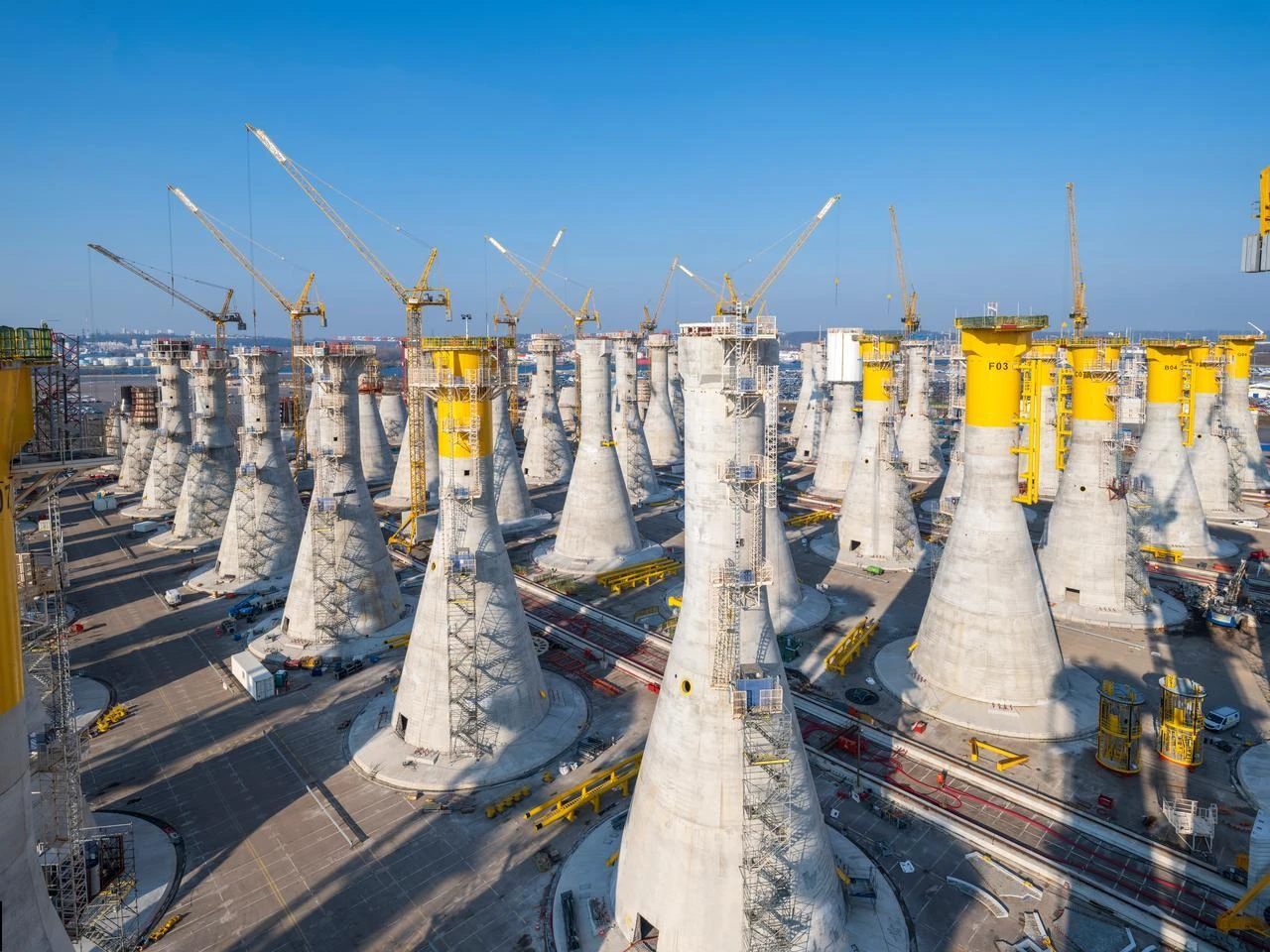
We also perform heavy lifting for the installation of the major structural components. At Fécamp, in France, 71 gravity-based foundations were produced on four parallel lines and delivered in 21 months. In our model, the construction phase is directly linked to upstream engineering and to installation operations.

Safe and precise offshore installation
We handle the transport and placement of foundations at sea. Our marine assets and expertise ensure gravity-based and floating structures are installed safely, accurately and on schedule. This final stage demonstrates the end-to-end role we play in projects, linking design, financial engineering and construction through to commissioning.
Do you have a project?
Let's discuss it.
Gravity‑based foundations, a proven solution
Our gravity‑based structure (GBS) foundations sit on a hollow prestressed concrete base laid on the seabed over a gravel bed and filled with ballast. These foundations eliminate the need for offshore driving or drilling of large‑diameter piles, avoiding underwater noise and the additional costs associated with complex geotechnical conditions. With lifespans that can exceed 100 years and minimal maintenance requirements, GBS deliver optimal performance for turbines from 7 MW up to 20 MW and beyond.
Our flagship project in Fécamp, France, illustrates our expertise: 71 foundations of 5,000 tonnes each were produced on four parallel production lines and delivered just 21 months after construction began, with a peak workforce of 1,000 people.
This industrial approach optimises design, methods and transport simultaneously, for GBS designed to the highest standards of precision.
Floating foundations are the offshore solution of the future
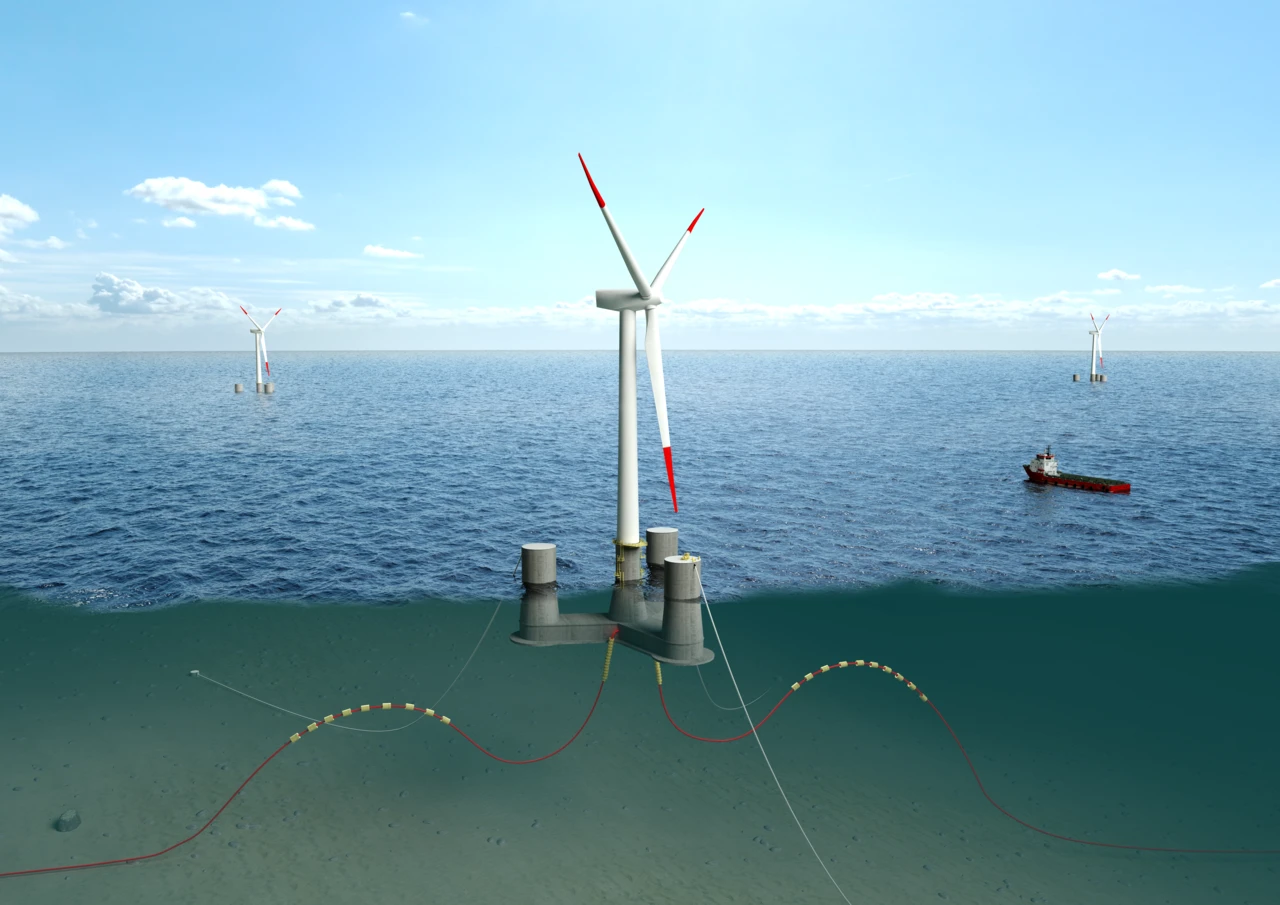
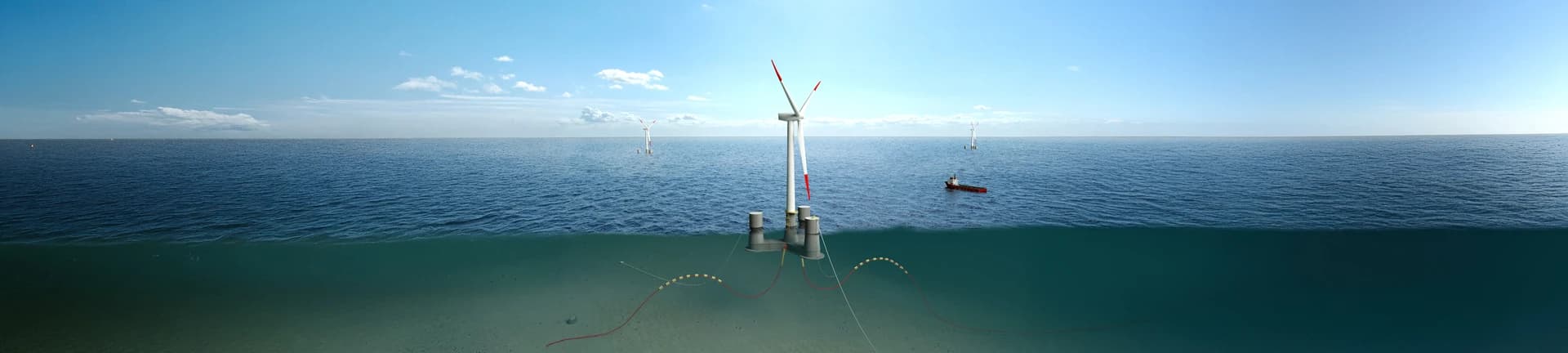
For deep waters beyond 60 to 70 metres, our OO‑STAR floating foundations offer a solution for the future. This semi‑submersible technology consists of a platform with three satellite pontoons arranged around the central floater that supports the wind turbine. It allows the capture of stronger, more constant winds with higher‑capacity turbines, which contributes to optimising investment costs.
Resulting from 15 years of research and development by Dr Olav Olsen, the OO‑STAR ensures optimal turbine performance even in the harshest weather conditions. Designed for modular construction, this floater can be assembled either at quay or offshore with a moderate draught.
Our commitment to sustainable development includes the use of low‑carbon concrete and steel. We are also exploring synergies with hydrogen production and storage within the floaters.
Our projects
Fécamp offshore wind farm
Construction and installation in record time of the gravity foundations for the 71 wind turbines at the Fécamp offshore wind farm in Normandy.
.webp&w=1920&q=75)
Floatgen Project
Construction of the ‘Damping Pool’ floating foundation made of lightweight concrete, which supports France’s first floating wind turbine.
OO-STAR
An innovative floating base technology offering increased efficiency, high durability and optimised operating and maintenance costs.

Tampen Hywind Offshore Wind Farm
VSL was responsible for the post-tensioning of the semi-submersible concrete structures which required the installation of 660 vertical post-tensioning tendons up to 85 m-long in the hulls.

Join the team
Find a job among the 1,000+ opportunities currently available.Join the team